
1. Handloom Mark Scheme
The Handloom sector is not just a vital economic contributor but a living embodiment of India’s artistic legacy. Across the country, generations of weavers have kept this heritage alive with skill, patience, and pride, producing textiles that reflect the soul of their communities. The sector provides sustainable livelihoods to millions, especially in rural and semi-urban areas, empowering families and preserving age-old traditions.
Handloom textiles constitute a timeless facet of the rich cultural heritage of India. As an economic activity the Handloom sector occupies a place second only to agriculture in providing livelihood to the people. According to All India Handloom Census, the total household engaged in handloom like weaving and allied activities is 31.45 lakh (2019-20) working on approximately 28.2 lakh handlooms. The four states of Assam (10.9 lakh), West Bengal (3.4 lakh), Manipur (2.1 lakh) and Tamil Nadu (1.7lakh) account for 18 lakh households. Nearly 88.7 per cent households are located in rural area and 72 percent of workers are female. The annual production of handloom fabric is estimated to be approximately 6806 Mn.Sq.m which accounts around 15% to India’s total textile production. Unique products produced on handloom include Sarees, Shawls, Mekhla, Chaddar, Loi, Stole, Scraf and Mufflers, Angavastram, Dhoti, Sarong and Lungi Bedsheets and other Furnishing cloths Dress materials, Shirting, Long cloth, Surgical Bandage, etc. Through these varieties of products the traditional hand weavers produce unimaginable creative on cloth. However, the unregulated use of the phrase “Handloom” has allowed non-handloom products to flood the market, causing misrepresentation and unfair competition. Mass-produced powerloom and mill-made items often masquerade as handloom, eroding consumer trust and placing genuine artisans at a disadvantage. This situation has not only affected the income of traditional weavers but has also blurred the lines between authenticity and imitation. When buyers cannot differentiate between hand woven and machine-made, the value of genuine craftsmanship diminishes.
2. Handloom Mark Scheme – The Govt of India Initiative
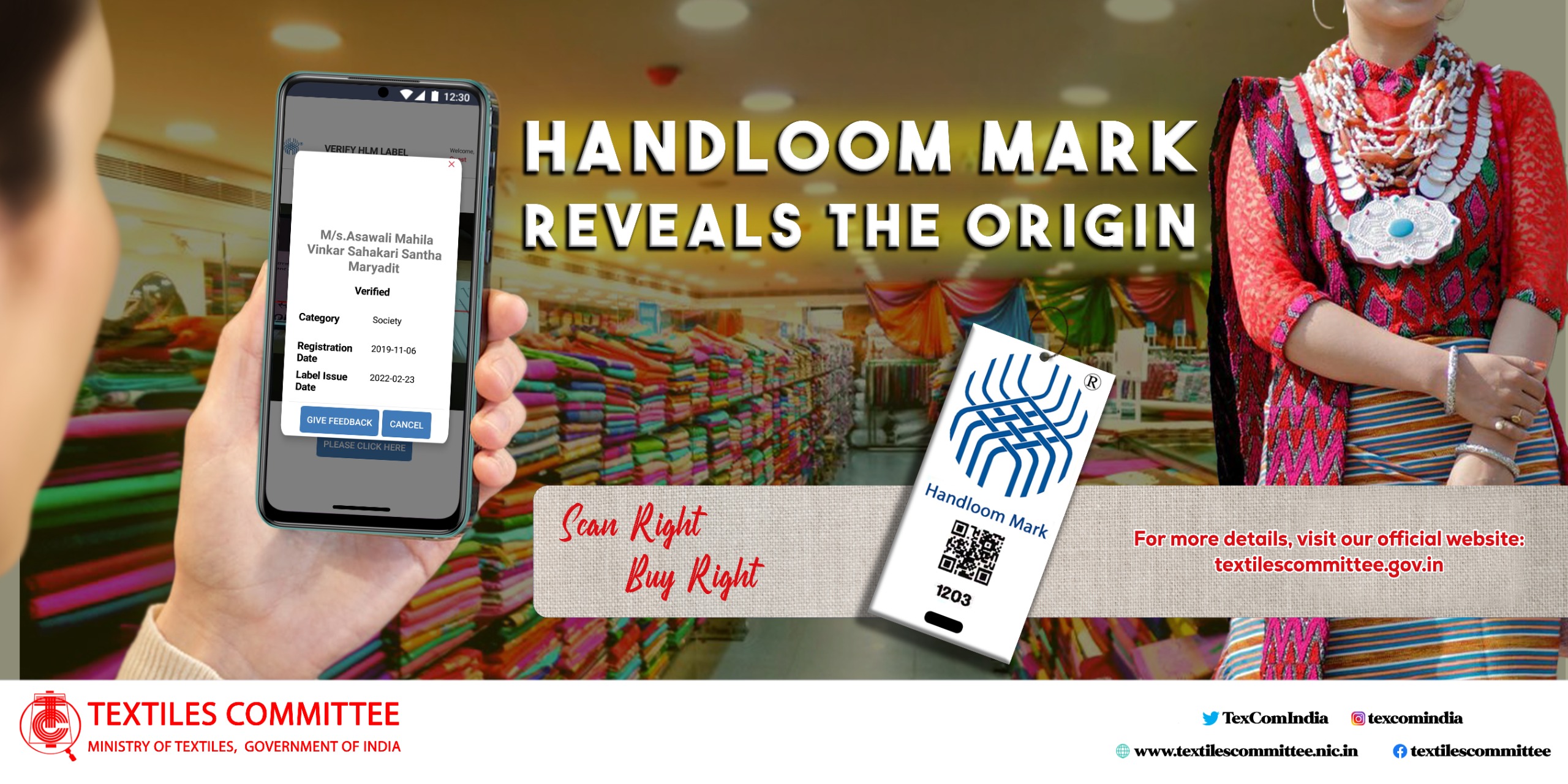
Understanding these problems the office of the Development Commissioner for Handloom (O/o DCHL) under the Ministry of Textiles, Government of India has launched Handloom Mark (HLM) scheme in the august hands of then Hon’ble Prime Minister of India on 28.06.2006. The Handloom Mark is hallmark of powerful creative work that defines the product with clarity, distinguishes it from competition and connecting it with customers. The Handloom Mark provides a collective identity to the handloom products and can be used not only for popularising the hand woven products but can also serve as a guarantee for the buyer.
The basic objective of the Scheme is to
• Provide unique identity
• Brand India’s handloom products and
• Secure a premium position for them in domestic as well as international market.
The Textiles Committee has been Implementing Agency of HLM scheme since its launch during 2006.
3. Handloom Mark & Logo
Handloom Mark logo was developed by the NID, indicates interlocking of warp and weft yarn symbolising the collaborative institutes giving their inputs and artisans giving their skill. The Handloom Mark and logo has been registered as Certification Trade Mark under the Trade Mark Act 1999 and therefore restricted to be used only by registered users.

4. HLM Labels
Specially designed polyester taffeta labels containing Handloom logo and unique QR Codes are affixed to all hand woven fabrics and products. Handloom Mark Label provides an unique identity and traceability of the product. The non-reproducible and unique QR codes printed on each labels trace the label to the producer. This ensures complete originality and genuineness of the product about the loom origin. This handloom mark therefore acts as market linkage to the weavers. The labels are currently being sold for 50 paisa per labels.

5. Registration under Handloom Mark Scheme.
Anyone involved in the production of handloom merchandise like Individual weavers, Master weavers, Apex & Primary handloom weavers Co-operative societies, Handloom development corporations, Self Help Groups, Manufacturer – Exporters, etc are entitled to register in the scheme. For registration on-line application can be made through dedicated portal www.hlm.gov.in. Once the application is received, the on-site verification of the production centre will be conducted by the officials from Textiles Committee/Weavers Service Centre/any authorised agencies to confirm that the applicant is actually owns and produce on Handlooms. Based on the production pattern number of people involved in production and number of handloom annual label entitlement arrived.
So far more than 28,000 users under different categories are registered under the Handloom Mark Scheme throughout the country and more than 24 cr. products are tagged with Handloom Mark Labels. The registration so far has covered 6 lakhs weavers engaged in weaving on around 10 lakh handlooms.
Contact Details
Dr.K.S.Muralidhara, Joint Director
Tel: 022-66527524 / Mob: 9967533770
Shri Santosh P. Shinde, Assistant Director
Tel: 022-66527570 / Mob: 9620707102